You need to put a scannable code on a product, a label, or a printed piece. You know both QR codes and barcodes exist. You are not sure which one is right for your situation.
The answer depends on what you need the code to do. Barcodes and QR codes are built for different jobs. Using the wrong one for your use case either limits what you can store or uses more space than necessary.
This guide explains how each format works, what each one stores, the practical differences that matter for real-world use, and which one to choose for every common business scenario.
What is a Barcode?
A barcode is a one-dimensional pattern of parallel vertical lines of varying widths. Each combination of thick and thin lines represents a number. A barcode scanner reads those lines by shining a laser or LED across them and measuring the reflected light pattern.
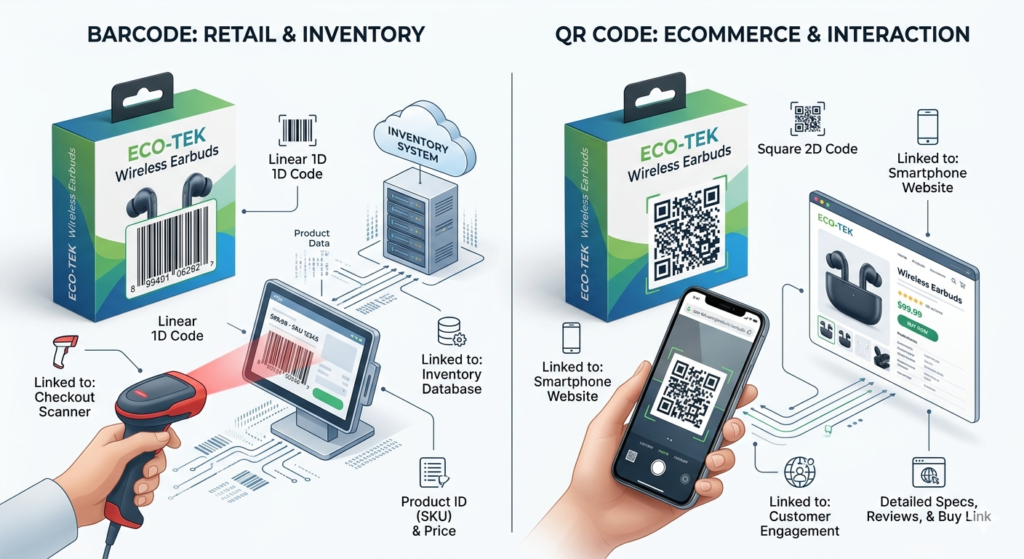
The most common barcode format in retail is the UPC-A barcode, which stores 12 digits. The EAN-13 format used outside the United States stores 13 digits. According to GS1, the global standards body for barcodes, these numeric codes are used to look up a product in a database. The barcode itself does not contain the product name, price, or description. It contains only a reference number that a point-of-sale system uses to find that information in its own database.
This is an important distinction. A barcode is essentially an ID card. It points to a record. It does not contain the record itself.
What is a QR Code?
A QR code is a two-dimensional pattern of black and white squares arranged in a grid. It stores data both horizontally and vertically, which is why it can hold far more information than a barcode of the same physical size.
Unlike a barcode, a QR code stores its information directly inside the code itself. A QR code containing a URL, a WiFi password, or a contact card does not need a database to look anything up. The full data is encoded in the pattern. When your phone scans it, the data is decoded on the spot.
QR codes were developed in 1994 by Masahiro Hara at Denso Wave, a Japanese automotive components company. The original purpose was tracking car parts in a factory, where barcodes did not hold enough data for complex supply chain identification. The format is governed by the ISO/IEC 18004 international standard.
How Each One Stores Data
The fundamental difference between barcodes and QR codes is dimensionality.
A barcode is one-dimensional. It encodes data along a single horizontal axis. The width and spacing of the lines represent values. Because data only runs in one direction, the total data capacity is limited by the physical width of the code.
A QR code is two-dimensional. It encodes data along both a horizontal and a vertical axis simultaneously. Every row and every column carries data. This is why the same physical footprint can store dramatically more information.
According to the official QR code specification maintained by Denso Wave, a single QR code can store up to 7,089 numeric characters or 4,296 alphanumeric characters. A standard EAN-13 barcode stores 13 digits. A QR code stores roughly 545 times more numeric data in a comparable physical space.
Key Differences at a Glance
| Feature | Barcode | QR code |
|---|---|---|
| Dimensions | 1D (horizontal only) | 2D (horizontal and vertical) |
| Data capacity | 8 to 20 characters typical | Up to 7,089 numeric or 4,296 alphanumeric |
| Data stored inside code | No (ID number only, database lookup required) | Yes (full data encoded in pattern) |
| Scanner required | Dedicated laser or LED scanner | Any modern smartphone camera |
| Scanning direction | Must scan horizontally | Any angle, any direction |
| Error correction | None or minimal | Up to 30% data recovery |
| Typical use cases | Retail pricing, inventory, supply chain | URLs, WiFi, contacts, social media, marketing |
| Database dependency | Yes, requires a backend system | No, self-contained |
What Barcodes Are Better At
Barcodes have been in commercial use since the early 1970s. According to GS1’s General Specifications, over 6 billion barcode scans occur every day globally across retail, healthcare, and logistics. That infrastructure is deeply established and is not going anywhere.
Barcodes work better than QR codes in several specific contexts.
Retail point-of-sale
Every supermarket checkout, every retail store, and every logistics warehouse is built around barcode infrastructure. The scanners, the software, and the workflows all assume barcodes. Putting a QR code on a product you intend to sell through existing retail channels is not practical. Retailers require GS1-registered barcodes for all products on their shelves. A QR code does not substitute for a UPC or EAN barcode in retail.
High-speed industrial scanning
In manufacturing and logistics, products move along conveyor belts at high speed past fixed laser scanners. These scanners are optimised for barcode reading at speed and with precision. They do not require any orientation or focus time. For this environment, barcodes remain the more reliable choice.
Healthcare item identification
Many hospital and medical supply systems use GS1-standard barcodes for medication tracking, surgical instrument identification, and patient records. The infrastructure is heavily standardised around barcodes. While QR codes are increasingly used in healthcare settings, replacing established barcode systems is a significant operational change.
What QR Codes Are Better At
QR codes outperform barcodes in every context where a consumer, rather than a machine, is the scanner, and where you need to store more than a short numeric ID.
Consumer-facing marketing and information
A barcode cannot link to a website, store a WiFi password, or save contact details to a phone. QR codes were designed for exactly these use cases. Any consumer-facing application where you want someone with a smartphone to access digital content from a physical item is a QR code job.
Contactless menus and information displays
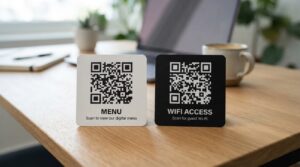
Restaurants, hotels, and event venues use QR codes to link physical spaces to digital content. A menu QR code, a WiFi QR code, and a Google review QR code all work because QR codes store full URLs, not just reference numbers. A barcode cannot do any of these things.
Marketing campaigns and print materials
Flyers, posters, business cards, packaging inserts, and direct mail pieces use QR codes to bridge print and digital. The QR code stores a full campaign URL, a social media profile link, or a landing page address. The person scans with their phone and lands exactly where the campaign intends. A barcode has no function in this context.
Self-contained data without a database
A QR code on a product tag stores the full product URL, a showroom WiFi password, or a sales rep contact card. No backend database needed. The data travels with the code. For small businesses and independent sellers who do not have a POS system or inventory database, QR codes are more practical than barcodes for almost every use case.
Scanning without specialist equipment
Reading a barcode requires a dedicated barcode scanner or a device running barcode scanning software. Reading a QR code requires only a smartphone camera. For any application where the person scanning is a consumer rather than an employee with specialised equipment, QR codes are far more accessible.
Can You Use Both on the Same Product?
Yes, and many products do exactly this. A product sold through retail channels needs a GS1 barcode for the checkout system. That same product might also carry a QR code linking to a product page, a how-to video, or a customer review prompt. The barcode handles the retail infrastructure. The QR code handles the consumer digital experience. They serve different purposes on the same label and do not interfere with each other.
This is common on consumer electronics, premium food products, and health and beauty packaging. The manufacturer links customers to digital content without replacing the retail barcode the distribution system requires.
Can a QR Code Replace a Barcode?
For retail and logistics, no. GS1 barcodes are a commercial and sometimes legal requirement for products sold through retail distribution. A QR code cannot substitute for a GS1-registered UPC or EAN barcode at a supermarket checkout or on a logistics label.
For every other use case outside of those established retail and logistics systems, a QR code is almost always the better choice. It stores more data, does not require specialist scanning equipment, works from any angle, and can be scanned by any modern smartphone without an app.
If you need a scannable code for marketing, customer engagement, or information sharing rather than retail checkout, a QR code is the right tool. Create one for free at toolshash.com in under 60 seconds with no signup required.
Create your free QR code at toolshash.com
Frequently Asked Questions
Is a QR code a type of barcode?
Technically, yes. QR codes belong to the broader category of machine-readable codes, which includes all barcode formats. In everyday language, when people say “barcode” they usually mean a traditional 1D linear barcode with vertical lines. A QR code is a 2D barcode, which is a distinct subcategory. The two terms are often used as opposites in conversation even though QR codes are technically a subset of the barcode family.
Can a smartphone read a traditional barcode?
Yes, but not always natively. Some smartphone cameras detect and decode 1D barcodes automatically alongside QR codes. Google Lens on Android and iOS 15 or later on iPhone can read many barcode formats. However, dedicated barcode scanning apps generally perform better for 1D barcodes than native camera apps, which are optimised primarily for QR code detection. For a QR code, any modern smartphone camera reads it natively without any app.
Do I need to register a QR code like I do a barcode?
No. GS1 barcodes require registration and a company prefix because they need to be unique globally across all products in the retail system. A QR code stores whatever URL or data you choose to encode in it. There is no registration body, no company prefix, and no cost beyond creating the code. Anyone can create a QR code pointing to any URL without registering it anywhere.
Which is more durable when printed on packaging?
QR codes are more damage-tolerant because of built-in error correction. The ISO/IEC 18004 standard defines error correction levels allowing up to 30% of the code to be obscured or damaged while still scanning correctly. Traditional linear barcodes have no meaningful error correction. A scratch, smudge, or fold across a barcode renders it unreadable. The same damage on a QR code using High error correction often still scans.
What is a 2D barcode?
A 2D barcode is any machine-readable code that stores data in two dimensions rather than one. QR codes are the most widely known 2D barcode format. Others include Data Matrix codes (widely used in healthcare and electronics), PDF417 (used on driving licences and boarding passes), and Aztec codes (used on rail tickets in several countries). All of these formats store more data than traditional 1D barcodes and can be read by smartphone cameras.
Why do some products have both a barcode and a QR code?
The barcode handles the retail point-of-sale system. The QR code handles the consumer digital experience. These are two separate jobs. The barcode on a box of cereal lets the supermarket checkout scan and price it. The QR code on the same box might link to a recipe page, a loyalty programme, or a product information page. Both codes serve their own purpose and do not interfere with each other.