Print a URL on a flyer and almost nobody types it. Add a QR code and the same person scans it without thinking twice. That gap — between a piece of physical material and a digital destination — is exactly where QR code marketing lives. And for businesses that still rely on print, events, packaging, or any physical touchpoint, that gap is one of the most underused conversion opportunities available.
This guide covers how to build a QR code marketing strategy that actually works, with practical ideas, real examples, and the technical setup that ties everything together.
Why QR Code Marketing Works
QR codes in marketing do one thing exceptionally well: they remove friction between seeing something and acting on it. A customer reads your magazine ad, sees a QR code, scans it in two seconds, and lands on your offer page. No URL to remember, no app to download, no form to fill in before getting to the content. The barrier between physical impression and digital action collapses.
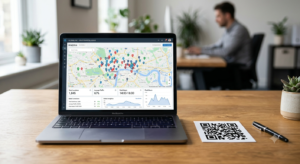
For marketers, the other major advantage is measurability. Every scan of a dynamic QR code generates data — how many people scanned, when they scanned, what device they used, where they were located. Print advertising has historically been impossible to measure with precision. A QR code changes that entirely, giving you scan-level attribution that approaches the granularity of digital campaign tracking.
To understand how scan tracking works in practice and how to connect it to Google Analytics, the QR code tracking guide covers the full setup including UTM parameters and GA4 reporting.
QR Code Marketing Strategy: The Basics
Before generating a single code, three questions shape every effective QR code marketing campaign.
What is the destination?
The landing page a QR code points to determines whether the scan converts or bounces. A generic homepage wastes the scan. A campaign-specific landing page that matches the message on the physical material — same offer, same visual language, same call to action — converts far better. Treat the landing page as part of the QR campaign, not an afterthought.
Mobile optimisation is non-negotiable. Every person who scans a QR code arrives on a mobile device. A landing page that loads slowly, renders poorly on a small screen, or presents desktop-sized text and buttons loses the conversion before it starts.
What do you want the person to do?
Every QR code in a marketing context needs one clear call to action. Claim this offer. Book a table. Download the guide. Watch the video. Multiple actions on the landing page dilute focus and reduce conversion. One destination, one goal per code.
How will you measure it?
Use dynamic QR codes with UTM-tagged destination URLs for every marketing campaign. This gives you scan data from the QR platform and session and conversion data in Google Analytics. Without measurement, you cannot improve what you are doing or prove ROI to anyone who asks.
QR Code Marketing Ideas by Channel
QR Codes on Flyers and Posters
Flyers and posters are the most common QR code placement in marketing. The code bridges the physical distribution — a stack of flyers at a coffee shop, a poster at a bus stop — with a digital destination that does the conversion work. Place the QR code prominently, add a short call-to-action label beneath it such as “Scan for 20% off” or “Book your table,” and make sure the landing page delivers exactly what that label promises.
For outdoor posters scanned from a distance, size the QR code to at least 5 x 5 cm. For smaller flyers scanned by hand, 3 x 3 cm is the practical minimum. Always use a dynamic code so you can update the destination if the offer changes without reprinting.
QR Codes in Direct Mail
Direct mail response rates improve when a clear next step is easy to take. A QR code on a postcard, letter, or mailer gives recipients an immediate path from physical piece to digital action — landing page, discount code, video, or form. Direct mail QR codes benefit especially from personalised URLs where each recipient gets a unique code pointing to a personalised landing page, enabling individual-level tracking of who opened and scanned.
QR Codes on Product Packaging
Packaging QR codes extend the customer relationship beyond the point of purchase. Common destinations include how-to videos, recipe ideas, warranty registration forms, loyalty programme sign-ups, and review request pages. Because packaging QR codes remain in homes long after purchase, they generate scans over extended periods — making them one of the highest-value placements for ongoing engagement.
QR Codes in Email Marketing
Embedding a QR code in a marketing email serves a specific use case: the recipient reads the email on a desktop but wants to act on a phone. A QR code in the email body lets them scan from their computer screen to jump to a mobile experience — a app download, a mobile checkout, or a location-specific offer. For standard email-to-web conversions, a regular hyperlink works better. QR codes in email add value specifically when the mobile device is the intended action environment.
QR Codes on Social Media
QR codes work on social media in two directions. First, as images in posts or stories that link to a destination the platform’s algorithm might otherwise suppress in link-heavy content. Second, as offline-to-online bridges where a social post promotes a physical QR code placement and vice versa. Brands in retail and hospitality use this combination — a QR code in-store links to a social campaign, and the social campaign drives foot traffic to the physical location.
QR Codes at Events
Events generate dense, time-sensitive QR code marketing opportunities. Sponsor logos on lanyards and badge holders with scannable QR codes. Speaker presentation slides with QR codes linking to resources or contact details. Booth displays where visitors scan to download materials, enter competitions, or book follow-up calls. Post-event, QR codes on printed programmes or feedback cards link to digital surveys or recording archives. Dynamic codes let organisers update destinations in real time if schedules change.
QR Code Call to Action Best Practices
A QR code sitting on a piece of printed material without any context around it converts poorly. People scan more readily when they know what to expect. Adding a short instructional or benefit-focused label below the code — a call to action — removes hesitation and increases scan rates consistently.
Effective QR code call-to-action examples include:
- “Scan to claim your free trial”
- “Scan for the full menu”
- “Scan to book a free consultation”
- “Scan to watch how it works”
- “Scan for exclusive discount”
- “Scan to connect on LinkedIn”
Keep the label to five to eight words. Put it directly below the QR code in a readable font size. If space allows, add a brief URL beneath the call to action so people who prefer to type still have a path to the destination.
QR Code Landing Page Best Practices
The scan is only the first step. What happens on the landing page determines whether the campaign delivers a return.
- Match the message: The landing page headline and offer should directly reflect the call to action on the physical material. Consistency between the two builds trust and reduces bounce rate.
- One clear action: Remove navigation menus, sidebars, and competing links from QR landing pages. One goal, one button.
- Mobile-first design: Large text, thumb-friendly buttons, minimal form fields, and fast load time. Every visitor arrives on a phone.
- Fast load time: Pages that take more than three seconds to load lose a significant portion of mobile visitors. Compress images and minimise redirects on QR landing pages specifically.
- Track conversions: Set up a goal or conversion event in Google Analytics for the desired action on the landing page. Combined with UTM-tagged QR codes, this gives you end-to-end attribution from physical scan to completed conversion.
QR Code Advertising Examples
Understanding where QR codes work in advertising helps frame where to test them in your own campaigns.
Retail: shelf-edge QR codes linking to product detail pages, comparison guides, or video demonstrations give shoppers additional information at the point of purchase decision without requiring staff involvement.
Hospitality: table QR codes linking to menus, booking forms, and loyalty programme sign-ups are now standard in many markets after widespread adoption during the pandemic period.
Real estate: property listing QR codes on physical signage link to virtual tours, floor plans, and agent contact forms — giving potential buyers instant access to detailed information while standing outside the property.
Healthcare: appointment reminder letters with QR codes linking to online check-in forms or preparation instructions reduce phone call volume and improve patient experience simultaneously.
Each of these examples uses the same principle: identify a friction point between a physical touchpoint and a digital action, and place a QR code exactly there.
How to Create a QR Code for a Marketing Campaign
- Define the campaign destination URL and build the landing page before generating the code
- Add UTM parameters to the destination URL to enable Google Analytics attribution
- Generate a dynamic QR code using the QR code generator and paste the UTM-tagged URL as the destination
- Customise the design to match your brand — colours, logo, and style that fits the material
- Download in SVG for print materials or high-resolution PNG for digital use
- Add a clear call-to-action label beneath the code on the physical material
- Test the scan on multiple devices before finalising any print run
- Monitor scan data in your QR platform dashboard and GA4 throughout the campaign
Frequently Asked Questions
What is QR code marketing?
QR code marketing uses scannable QR codes on physical and digital materials to connect audiences with a specific digital destination — a landing page, offer, video, or form. The primary advantage is bridging print and digital with a frictionless, one-step scan that requires no typing and generates measurable scan data.
How do I use QR codes in marketing?
Place QR codes on any physical or digital material where you want to drive a specific action — flyers, posters, packaging, direct mail, business cards, event materials, or email. Use dynamic codes with UTM-tagged destination URLs so every scan feeds data into your analytics. Add a clear call-to-action label below each code and send scanners to a dedicated mobile-optimised landing page.
What should a QR code landing page include?
A QR code landing page should match the call to action on the physical material, present one clear goal, use mobile-first design with large text and thumb-friendly buttons, load in under three seconds, and have a conversion event set up in Google Analytics. Remove navigation menus and competing links so visitors stay focused on the intended action.
How do I measure QR code marketing results?
Use dynamic QR codes that log scan data including count, time, device, and location in a platform dashboard. Add UTM parameters to the destination URL to track scan-driven sessions and conversions in Google Analytics. Together, these two data sources give you end-to-end attribution from physical scan to completed action on the landing page.
What is a QR code call to action?
A QR code call to action is the short instructional or benefit-focused label placed beneath a QR code on printed materials. It tells the person what to expect when they scan — for example, “Scan for 20% off” or “Scan to book a free consultation.” A clear call to action consistently increases scan rates compared to an unlabelled code.
What are some QR code advertising examples?
Retail shelf-edge codes linking to product pages, restaurant table codes linking to menus, real estate signage codes linking to virtual tours, direct mail codes with personalised landing pages, and event booth codes linking to downloadable materials are all established QR code advertising applications. Each places the code at a friction point between a physical touchpoint and a digital action.
Bridge the Gap
Every piece of physical marketing material your business produces is a missed conversion if it does not include a clear path to a digital action. QR codes make that path immediate, frictionless, and measurable. The strategy is straightforward: define the destination, tag it for tracking, design the code to fit the material, and put a clear call to action beside it.
Start by creating your campaign QR code with the QR code generator — full design control, dynamic redirect support, and SVG download for any print size. And if you want to build the tracking layer first, the QR code tracking guide walks through the exact UTM and GA4 setup that makes every scan count.