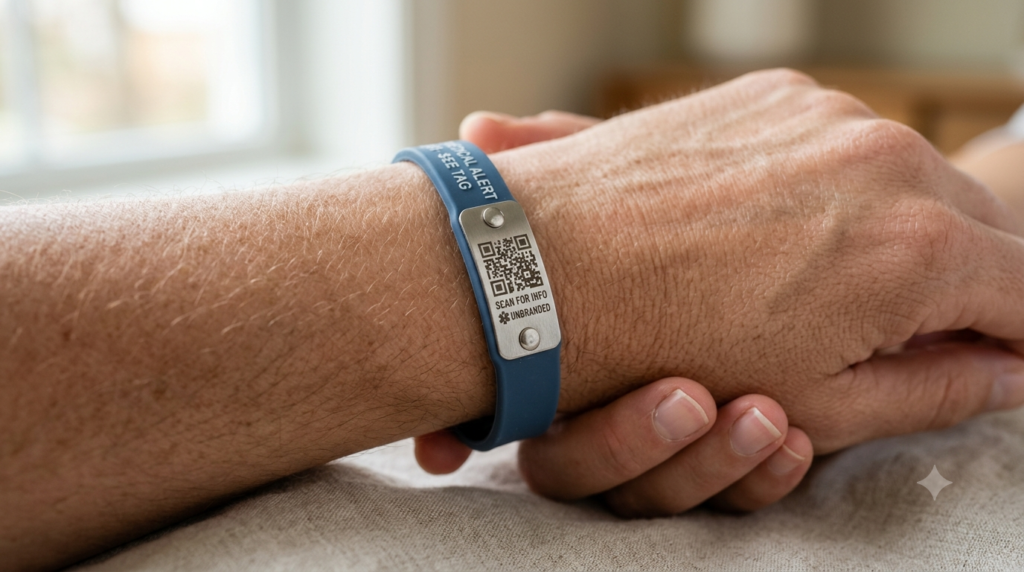
A QR code medical alert bracelet encodes your critical health information — allergies, medications, blood type, emergency contacts, medical conditions — into a scannable code worn on your wrist. In an emergency where you are unconscious or unable to speak, a first responder or bystander can scan the code and access everything they need to treat you safely within seconds.
This guide covers what information to include, how to create the QR code, which bracelet and engraving services work best, and the important limitations worth understanding before you rely on one.
What Is a QR Code Medical Alert Bracelet?
A QR code medical alert bracelet is a wearable piece of jewellery or a silicone band that displays or contains a QR code alongside standard medical alert text. When scanned, the code opens a page containing your medical information — either a dedicated medical ID service profile or a document you host yourself.
Traditional medical alert bracelets engrave a limited amount of text directly onto the metal — typically a condition name, a phone number, and the words “medical alert.” QR code versions extend this dramatically. A QR code can link to a page containing your full medication list, known drug allergies, blood type, primary care physician contact, emergency contacts, and any medical conditions relevant to emergency treatment — far more than any engraved bracelet could accommodate.
What to Include on a QR Code Medical Alert Bracelet
The information that genuinely matters in an emergency situation is different from what might seem important when you are sitting at a computer filling in a profile. First responders make treatment decisions based on a specific set of data points.
Include these in priority order:
- Known drug allergies: The single most critical piece of information. List the specific drug names and the type of reaction. Penicillin allergy with anaphylaxis response, for example, is more useful than “penicillin allergy” alone.
- Current medications: Full names and doses. A list of current medications tells a paramedic or ER physician what is already in your system and what interactions to avoid.
- Medical conditions relevant to emergency treatment: Diabetes, epilepsy, heart conditions, bleeding disorders, and similar conditions that directly affect how you should be treated in an emergency.
- Blood type: Useful if a transfusion is needed quickly before a cross-match can be done.
- Emergency contacts: At least two people with phone numbers — primary contact first, then a backup.
- Primary care physician or specialist: Name and contact number for your GP or the specialist managing your primary condition.
- Do Not Resuscitate (DNR) or advance directive status: If applicable. This should be explicitly noted and ideally supported by a reference to where the legal document can be accessed.
What to leave out: general biographical information, insurance details, and anything that is not directly relevant to emergency medical decisions. The page a first responder scans needs to deliver critical information immediately — a cluttered profile with irrelevant content slows that down.
How to Create a QR Code for a Medical Alert Bracelet
Two approaches work for creating the QR code content: using a dedicated medical ID service, or hosting the information yourself.
Option 1: Dedicated Medical ID Services
Several services specialise in QR code medical IDs. They provide a structured profile where you enter your medical information, and the service generates a QR code that links to your profile. When someone scans the code, they see your information in a clean, readable format designed for emergency contexts.
Well-known services include Road iD, ICE (In Case of Emergency) Wallet Card services, and several dedicated medical ID platforms. These services store your information on their servers, which creates one important dependency: if the service shuts down or experiences an outage, the QR code no longer works. For this reason, choosing a service with a long operational history and clear data continuity policies matters significantly for a use case where reliability is critical.
Most dedicated medical ID services charge a subscription fee. The subscription maintains the hosted profile and keeps the QR code active. If the subscription lapses, the code may stop resolving to your information — a critical failure mode for a safety device. Always understand the subscription terms before relying on a service for a medical alert bracelet.
Option 2: Self-Hosted Information Page
A more reliable long-term approach for technically capable users is to host the medical information yourself. Create a simple page on your own website or a stable hosting platform — Google Sites, Notion (with a public link), or a personal domain — containing your medical information in a readable format.
Generate a QR code pointing to that page using the QR code generator and use a dynamic code so you can update the information if medications or conditions change without replacing the bracelet. The dynamic code always points to the same URL, but you update the page content when your medical situation changes.
The advantage of self-hosting is complete control and no subscription dependency. The risk is that if your hosting lapses — your domain expires, your website goes down, or the platform changes — the code stops working. For self-hosted medical ID pages, using a stable platform with automatic renewal and backups is essential.
Getting the QR Code onto a Bracelet
Several options exist for getting the QR code physically onto a wearable.
Laser Engraved Metal Bracelets
Laser engraving etches the QR code pattern directly into stainless steel, titanium, or other metal surfaces. The engraved code is permanent and does not fade, wash off, or degrade with normal wear. This is the most durable option for a medical alert bracelet intended for daily wear.
The technical requirement for engraved QR codes is module size. Individual modules need to be large enough to be captured by a smartphone camera — at least 1.5 to 2 mm square for a reliable scan. This constrains the overall code size: a Version 1 or 2 QR code (21×21 or 25×25 modules) at 2mm per module requires approximately 4 to 5 cm of surface area. Most medical alert bracelets accommodate this on a standard tag or ID plate.
Keep the encoded data as simple as possible for engraved codes. A short URL pointing to a hosted page is significantly easier to engrave reliably than encoding the full medical information directly into the pattern. A URL of under 30 characters produces a very simple QR code that engrave cleanly at small sizes.
Printed or Sticker QR Codes on Silicone Bands
Silicone and rubber medical alert bands can carry printed QR code stickers or have the code printed directly onto the band surface. This approach is less durable than engraving — printed codes can fade, peel, or become unreadable with prolonged wear and washing. For a medical device intended for daily long-term use, printed codes require periodic inspection and replacement when the code shows wear.
Dedicated Medical ID Services with Integrated Bracelets
Several medical ID services sell bracelets with the QR code pre-applied or engraved as part of the service package. This is the most convenient option — the profile setup, code generation, and bracelet production happen through one provider. The trade-off is cost and the subscription dependency already noted.
Important Limitations to Understand
A QR code medical alert bracelet is a useful tool, but several real limitations affect how reliably it works in an actual emergency.
Smartphone required: Scanning a QR code requires a working smartphone with camera access. Not every first responder will immediately reach for a phone to scan a bracelet, particularly in high-intensity emergency situations where physical assessment takes priority.
Internet connection required: If the QR code links to a hosted page, scanning it requires an active data connection. In areas with poor mobile coverage, the page may not load when most needed.
Not a substitute for traditional medical ID: Many emergency protocols still prioritise physical text on a medical alert bracelet — engraved condition names, drug allergy warnings, and emergency numbers that are readable without any technology. The most robust solution combines engraved text for the most critical single-line information (ALLERGIC TO PENICILLIN, DIABETIC, DO NOT RESUSCITATE) with a QR code for comprehensive additional detail.
Service dependency: Any QR code linked to a third-party service is only as reliable as that service’s continued operation. Self-hosted solutions introduce hosting dependency instead. Neither is perfectly failsafe — understanding this trade-off is essential when choosing an approach for a life-safety application.
QR Code Bracelet for Non-Medical Uses
Beyond medical alerts, QR code bracelets and wristbands serve several other practical purposes:
- Children’s ID bracelets: A QR code on a child’s wristband for a theme park, event, or travel situation links to parent contact details and reunion information if the child gets separated
- Event wristbands: QR code wristbands at concerts, festivals, and events link to schedules, maps, or ticketing verification systems
- Pet ID tags: A QR code tag on a pet collar links to owner contact information and the pet’s veterinary records — more comprehensive than a standard engraved tag
- Dementia patient ID: QR code bracelets for dementia patients link to carer contact information and safe return guidance for anyone who encounters the wearer
Frequently Asked Questions
What is a QR code medical alert bracelet?
A QR code medical alert bracelet is a wearable band or piece of jewellery that displays a QR code linking to the wearer’s critical medical information — allergies, medications, conditions, and emergency contacts. When scanned by a first responder or bystander in an emergency, it provides comprehensive medical details that a standard engraved bracelet cannot contain.
What information should I put on a QR code medical ID bracelet?
Prioritise drug allergies with reaction type, current medications with doses, medical conditions relevant to emergency treatment, blood type, emergency contacts, and your primary care physician. Keep the information focused on what matters for emergency treatment decisions — avoid biographical and insurance details that are not relevant to immediate care.
How do I create a QR code for a medical alert bracelet?
Either use a dedicated medical ID service that provides a hosted profile and generates the QR code, or create a simple page on a stable hosting platform containing your medical information and generate a QR code pointing to it. Use a short, clean URL as the destination and a dynamic QR code so you can update the destination if your hosting changes without replacing the bracelet.
Are QR code medical bracelets safe to rely on?
QR code medical bracelets are a useful supplement to traditional medical alert text, not a complete replacement. They require a smartphone and internet connection to work, and depend on either a third-party service or your own hosting remaining operational. The most reliable approach combines engraved text for the most critical single-line information with a QR code for comprehensive additional detail.
What is the best QR code medical ID bracelet service?
Road iD is one of the most established services with a long track record. Several specialist medical ID platforms exist with varying subscription models and feature sets. When evaluating any service for a medical alert bracelet, prioritise uptime reliability, data continuity guarantees, and clear subscription terms — a service that expires your profile when a subscription lapses is a serious risk for a safety application.
How do I get a QR code engraved on a bracelet?
Use a specialist laser engraving service that handles QR codes — not all jewellers have experience with QR code engraving, and module precision matters for scannability. Keep the destination URL as short as possible to produce a simpler code that engraves more cleanly. Test a sample engraving by scanning before committing to the final production piece.
A Tool Worth Having, With Eyes Open
A QR code medical alert bracelet done well — reliable hosting, tested code, engraved physical backup, regularly updated information — adds genuinely useful emergency information capability to a traditional medical ID. Done carelessly — expired service, untested code, sole reliance on QR without physical text backup — it creates a false sense of security.
Start by creating a clean, short-URL QR code for your medical information page using the QR code generator. Keep the URL short, use a dynamic code for updateability, test it thoroughly before ordering any bracelet, and combine it with engraved physical text for the most critical information. And if you are thinking about QR codes for other wearable or event contexts, the QR codes for events guide covers wristband and badge applications in detail.